A Reconstructed Family Memoir
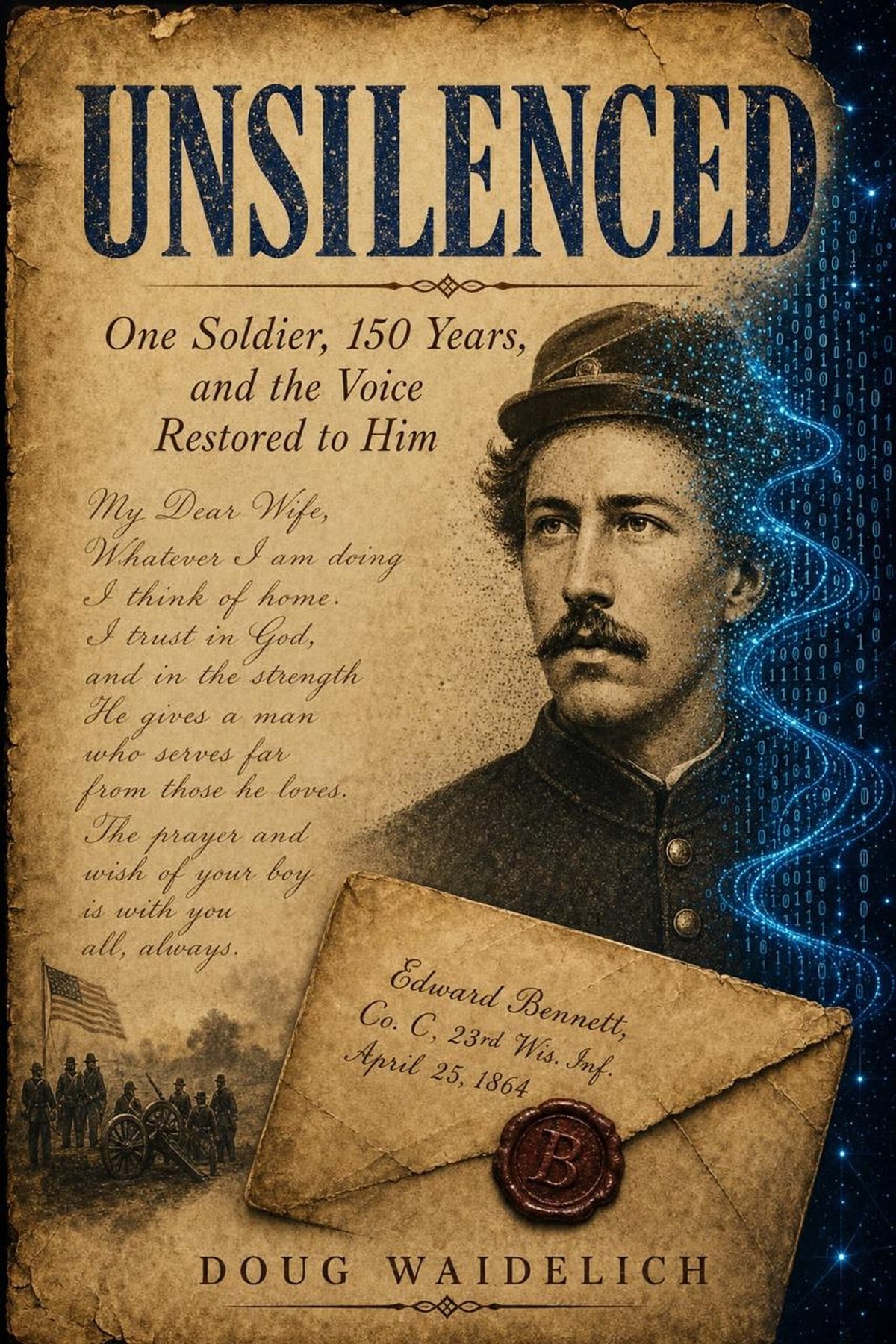
Unsilenced
One Soldier, 150 Years,
and the Voice Restored to Him
He has been heard.
Hardcover $32.95 · Foxhill Bank Press · ISBN 979-8-234-12450-0
Family member?
One Soldier, 150 Years,
and the Voice Restored to Him
He has been heard.
Hardcover $32.95 · Foxhill Bank Press · ISBN 979-8-234-12450-0
Family member?
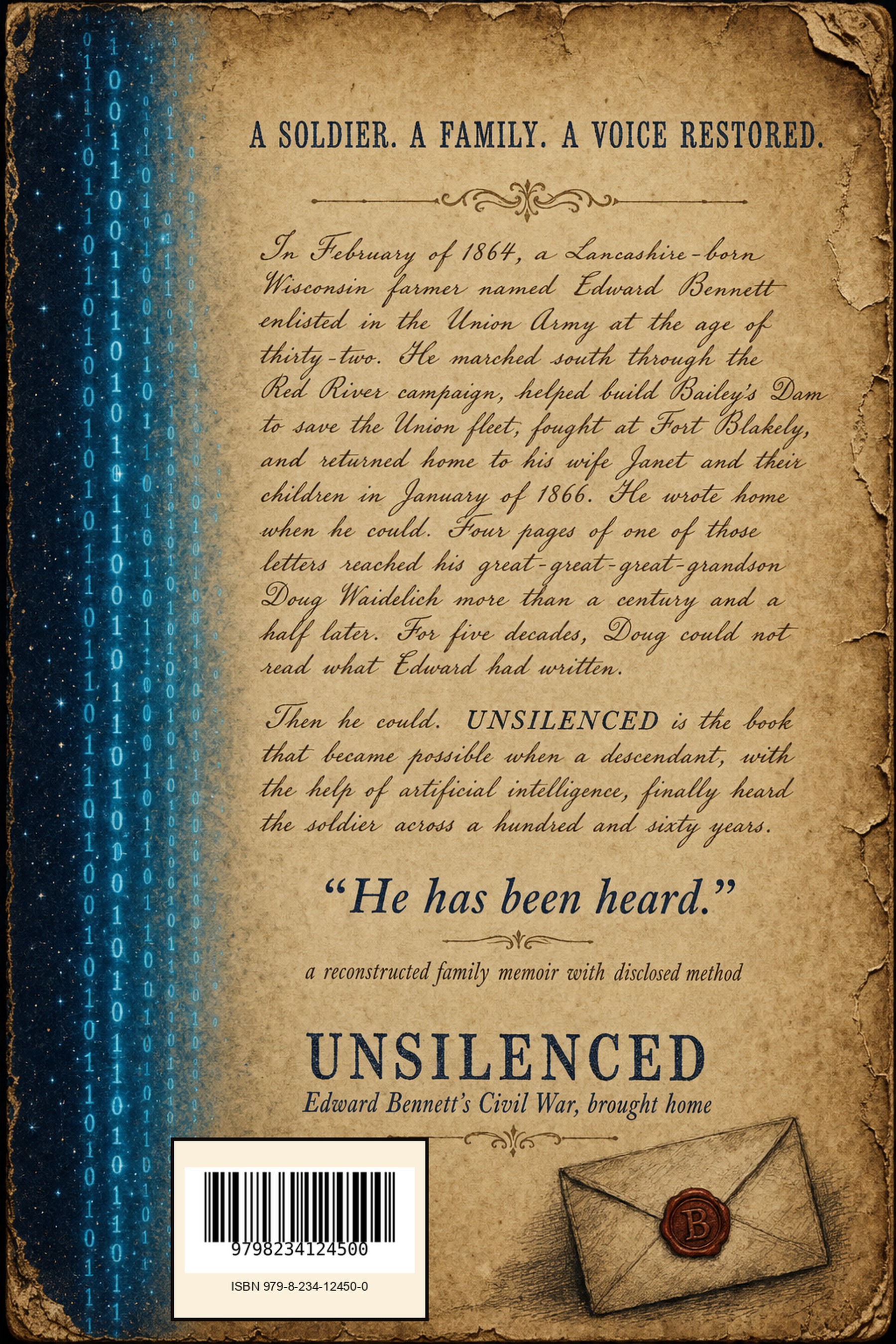
In February of 1864, a Lancashire-born Wisconsin farmer named Edward Bennett enlisted in the Union Army at the age of thirty-two. He marched south through the Red River campaign, helped build Bailey's Dam to save the Union fleet, fought at Fort Blakely, and returned home to his wife Janet and their children in January of 1866.
He wrote home when he could. Four pages of one of those letters reached his great-great-great-grandson Doug Waidelich more than a century and a half later. For five decades, Doug could not read what Edward had written.
Then he could.
Unsilenced is the book that became possible when a descendant, with the help of artificial intelligence, finally heard the soldier across a hundred and sixty years. It is part family memoir, part Civil War history, and part new method of doing both — a reconstructed narrative built entirely on the documentary record, with the method disclosed on every page.
Edward Bennett speaks again, six generations after he laid down the pen.
Chapter One · Read Free
I was born on December 16, 1964, in Nashua, Iowa, to Robert and Donna Waidelich. Nashua is a town small enough that the question of where you came from has only ever had a few answers, and most of them connect, eventually, to a farm.
In my case the farm sat two miles north of the Nashua fairgrounds, and it belonged to my grandparents, Don and Marian Zwanziger. I spent the better part of my boyhood there with my two cousins, Mark and Phillip. For any ten-year-old boy in the early 1970s, that farm was a kingdom. The barn was a fortress. The hay mound was a mountain you could fall off without dying. The fields ran out past where your eye could see them. We were small in a place that was large, and we knew it, and we loved it.
I knew my great-grandmother Jessie before she died, but I cannot honestly say I knew her well. She was Jessie Richards Shadbolt, my grandmother Marian's mother. She had eight children of her own, two of whom were Marian and her sister Joyce. By the time I met her she was living in a nursing home in Shell Rock, forty miles down the road. The visits were rare, and the woman I saw on those visits had already been worn down by illness. She did not speak very much. The family told me she had been a joyous person once. I had to take their word for it. The Jessie I knew was a quiet old woman whose body had outlasted whatever it was that had made her joyful.
She died in 1972. I was eight.
Three Decembers later, Christmas vacation of 1975, I was back at the farm. School was out. My cousins were home. Mark and Phillip and I were in my grandfather's hay mound that afternoon, building forts out of bales the way every farm boy who has ever been in a hay mound has built forts out of bales. The hay scratched. The air was cold above the bales and warm down inside them. Mark's birthday falls on December 31, which meant that for the two weeks every year between his birthday and ours we were all the same age. That fortnight was our season. We were ten years old together, lost in the work of small empires.
My grandmother Marian and her sister Joyce had spent that day at Jessie's house in Shell Rock. Jessie had been gone about three years by then. Her things had been sitting in her attic the whole time, waiting. Marian and Joyce had gone over to begin the work of going through them.
That evening they came back to the farm. They called us in from the hay mound. Mark, Phillip, and I climbed down out of the bales and came into the kitchen.
They had two boxes with them, and a uniform.
The boxes held letters. The letters had been written by a man named Edward Bennett, who was my great-great-great-grandfather. He had served two years in the Union Army during the Civil War. The uniform was the one he had worn.
My grandmother held that uniform up against my ten-year-old body. I remember her doing it. I remember the room. I remember how the uniform looked, hanging there in her hands, faded but still recognizable as what it had been a hundred and ten years before.
I have to say — it might have fit.
The rest of Chapter 1 continues in the book — the story of five decades of trying, and finally, of hearing him.
Buy the Book on Amazon
For family members and close friends. Fill this out and Doug will be in touch about getting a copy to you.